
Soft Spongy Bengali Rasgulla (Pressure Cooker & Open pot method)
Rasgulla is a Bengali sweet made with fresh chenna, cooked in sugar syrup, then chilled until it absorbs the syrup. For soft spongy Bengali rasgulla, the starting point is fresh, moist chenna kneaded into a smooth dough.
You can make these sweets in either a stovetop pressure cooker or an open pot, using the same ingredients and preparation.
The cooking method matters, but the chenna needs the most attention. Start with its moisture and texture, then allow plenty of time for the finished sweets to soak.

Bengali rasgullas are among the best-loved sweets of eastern India, a region known for its many delicious chenna-based treats. My family and I love them. Although rasgullas can be tricky to make, I've simplified the process so you can prepare them at home. They also aren't fried, and you can enjoy them with less syrup by gently squeezing a little out before serving. It's a lovely way to enjoy a sweet treat with a little less guilt.
Two ways to make soft, spongy Rasgulla
This rasgulla or kesar elaichi rasgulla recipe includes two cooking methods: an open pot and a pressure cooker. Both start with fresh chenna, kneaded until smooth and shaped into crack-free balls.
For the open-pot method, cook the rasgullas in boiling syrup in three stages. For the pressure-cooker method, cook them for one whistle on high heat, followed by five minutes on low. Let the cooker cool before opening it.
Once cooked, let the rasgullas soak up the syrup. Add kewra water after the mixture has cooled, then chill the rasgullas for 4 to 5 hours before serving. We prefer them less sweet, so adjust the sugar to suit your taste.

Gather the Ingredients and Prepare Fresh Chenna
You don't need flour or semolina for this recipe. Fresh milk, a little acid, sugar, and water make the basic sweet; the flavorings are optional.
Gather these ingredients before heating the milk:
- 1 liter cow's milk, about 4¼ US cups.
- Lemon juice or plain white vinegar, added gradually as needed to curdle the milk.
- About 1 liter of water for cooking, plus a little extra if needed.
- 125 grams of granulated sugar, divided.
- Optional cardamom, saffron, and kewra water for flavor.
Reduced-fat cow's milk works well, especially where milk has a higher fat content. In the US, 2% milk is a practical choice. I used 3.5% milk here because it's readily available in Ireland.
If you're using buffalo milk, bring it to a boil, then let it rest until a layer of cream forms on top. Skim off the cream, bring the milk to a boil again, and then use it to make the chenna.
Bring the milk to a boil in a heavy-bottomed saucepan, stirring occasionally to prevent scorching. Once boiled switch off and let it rest for 2-3 minutes.
Now mix lemon/lime juice or vinegar with water. We always want to dilute the acid with water.
Stir gently and add more diluted acid only as needed. Stop once the milk separates into white curds and pale, watery whey. Avoid pouring in a large amount of acid at once.
Pour the mixture into a muslin-lined colander. Rinse the curds briefly under cool water to remove the sour taste and stop further cooking.
Gather the cloth and let the whey drain away. I always put a heavy weight on top and leave it for 30 minutes to rest.
Use the fresh chenna within about an hour. Keep it covered while preparing your work surface so the exposed curds don't dry out.

How to Make Soft Spongy Bengali Rasgulla
Both methods begin with the same kneaded chenna and lightly sweetened cooking water. Choose one cooking method, then finish with the syrup soak.
Knead the Chenna and Shape Smooth, Crack-Free Balls
Place the drained chenna on a clean plate or smooth work surface. Break up larger pieces with your fingers, then press and smear the curds with the heel of your palm.
Gather the mixture back together and repeat for about 4 to 5 minutes. As you work, the grainy curds should become soft and lump-free.
Use the texture as your guide as well as the clock. The chenna should hold together without obvious grains, but it shouldn't become greasy from excessive kneading.
Divide it into equal portions so the balls cook at a similar rate. Press each portion firmly together first, closing any gaps inside.
Then roll gently between your palms to make smooth balls about 2 centimeters wide. Check the surface for cracks and smooth them before cooking.
Make a small indent in the centre of each portion and add a few cardamom seeds. Gently seal the chenna around them and roll it smooth. The cardamom adds a lovely flavour without making the rasgullas firm.
Work efficiently once you begin shaping. Leaving the balls uncovered for too long can dry their surfaces. Have the cooking water almost ready, and keep any waiting portions loosely covered.
Cook Rasgulla in a Pressure Cooker
Use a stovetop, whistle-type pressure cooker with enough room for the balls to expand. Follow its minimum-liquid and maximum-fill limits.
Add about 1 liter of water and ¼ cup of sugar to the cooker. Add saffron strands if using; this will colour the rasgulla yellow. Bring it to a boil and stir until the sugar dissolves.
Gently lower the chenna balls one by one into the boiling liquid. Avoid dropping them from a height or packing them tightly together.
Close the cooker according to its instructions. Cook over high heat until it reaches full pressure and gives one whistle. Then lower the heat and simmer for 5 minutes.
After 5 minutes, turn off the heat. Release the pressure, and now let the cooker cool down for 30 minutes before opening the lid.
Once cooled enough to handle safely, open it carefully. Lift out the rasgulla gently with a slotted spoon.
Keep them in a bowl with a little cooking liquid while you finish the syrup. Reserve the remaining liquid rather than discarding it.
Electric pressure cookers don't use whistles, so this timing shouldn't be transferred directly to an electric model. I have yet to work on an Electric pressure cooker, so I cannot comment on the timings for the same.
Cook Rasgulla in an Open Pot
Choose a wide, deep pot that gives the balls room to move and swell. A small saucepan can crowd them even when it holds enough water.
Bring about 1 liter of water and one-quarter of the sugar to a boil. Add saffron strands if using; this will colour the rasgulla yellow. Stir to dissolve the sugar, then gently add the shaped balls.
Cook over medium-high heat for 20 minutes, maintaining a steady boil. Keep enough water in the pot for the rasgulla to expand freely.
After about 10 minutes, check the cooking liquid. It may have reduced, and you want to keep it thin rather than let it become a thick syrup. If needed, add a little hot water at a time. Adding it all at once can lower the temperature suddenly and shock the rasgullas.
Do not stir the rasgullas with a spoon while they cook, as this can damage their delicate shape. If needed, gently swirl the pot to move them around.
The rasgulla should swell as they cook. When the cooking time is complete, cover and let it cool down in the pot for 30 minutes.
Transfer them to a bowl with a little cooking liquid, and keep the rest of the liquid for the final syrup.
Finish the Syrup and Let the Rasgulla Soak
Add the remaining sugar to the reserved cooking liquid. Bring it to a brief boil, stirring until the sugar dissolves.
Keep the syrup thin and pourable. There's no need to reduce it to a sticky consistency or test for a sugar thread.
Let it cool for about 30 minutes. Then gently add the sugar syrup to the cooked rasgulla, with the small amount of liquid holding them.
If you're using kewra water, wait until the rasgullas have cooled completely, then add a little at a time. Its floral aroma can quickly overpower the mild flavour of the chenna.
Cover and refrigerate the rasgullas in their syrup for at least 4 to 6 hours or more. This resting time allows the syrup to soak into the sweets, so plan to make them ahead.
Don't leave the batch on the counter for the entire soaking period.
If necessary, divide a large batch between shallow containers so it cools faster. Keep the sweets covered by syrup, and handle them gently when transferring.
Get a Soft Texture, Fix Common Problems, and Serve
Soft spongy Bengali rasgulla depends on several small details working together. After cooking, assess the shape and texture before deciding what to change next time.
Prevent Hard or Flat Rasgulla
Hard rasgulla often starts with chenna that's too dry. Heavy squeezing or prolonged draining removes moisture that the dough needs. The curds should feel soft when you begin kneading.
Chenna that's too wet creates a different problem. If it releases water when pressed or won't hold its shape, let it drain a little longer before kneading.
Don't add extra flour simply to make wet chenna easier to handle. Correct the moisture first, because adding a binder changes this recipe.
Insufficient kneading leaves grains and weak spots. Meanwhile, cracks in the shaped balls can open further during cooking. Press each portion together before rolling, then inspect its surface.
The cooking liquid also affects the result:
Start with only one-quarter of the sugar in the cooking water. Add the rest after the rasgulla have cooked.
A strong initial syrup can prevent the balls from expanding properly. Too little water or a crowded pot can also produce hard, misshapen, or flattened sweets.
For the next batch, change the part that went wrong rather than changing everything. Dry, crumbly dough needs different handling than wet dough that won't form a ball.

Add Flavor and Serve Chilled
Plain rasgulla lets the fresh milk flavor come through. Serve it cold with a little of its soaking syrup rather than draining it completely.
For kesar rasgulla, steep a few saffron strands in a spoonful of warm syrup, then stir that liquid into the remaining syrup. It adds a gentle saffron flavor and golden tint.
Cardamom gives the syrup a warmer fragrance. You can infuse a lightly crushed pod while heating the syrup, then remove it before serving.
Kewra water offers a floral finish. Add a small amount to the cooled syrup, taste, and add more only if needed. You don't need to combine every flavoring in one batch.
For a different dessert, cooked chenna patties or balls soaked in sweetened, flavored milk become rasmalai. That's a separate milk-based finish rather than the clear sugar syrup used here.
Keep leftover rasgulla refrigerated in a covered container with their syrup. Use a clean spoon each time, and return the container to the refrigerator after serving.

Tender Rasgulla Starts With Fresh Chenna
Either cooking method can produce tender, syrup-soaked rasgulla when you start with moist, smoothly kneaded chenna. Shape the balls carefully, give them room to expand, and keep most of the sugar for the finishing syrup.
Allow the full chilled soak before serving. That patient final step gives the syrup time to reach the center.
Please rate the recipe and share how your batch turned out, including whether you used the pressure cooker or open-pot method.

So here goes the recipe of Homemade Soft Spongy Bengali Rasgulla
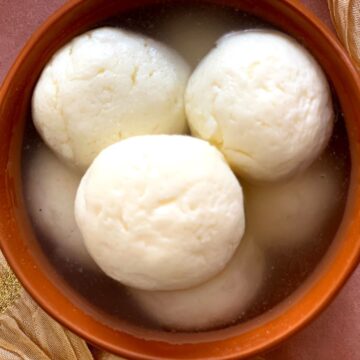
Soft Spongy Bengali Rasgulla (Stovetop pressure cooker or open pot)
 Print
Pin
Rate
SaveCook ModeShare Recipe
Ingredients
To make Paneer and Rasgulla
- 1 litre Milk Cow milk, or 3-4% Fat milk
- Lemon juice or plain white vinegar, diluted with a little water, as needed
For Syrup
- 1 liter Water - 4 Cups (Depending on your cooker size, you can add more or less), plus extra hot water if needed
- 125 gram sugar - Approximately ¾ Cup (can be more or less according to taste)
- Saffron Strands (Optional)
- 1 teaspoon Kewra Water (Optional)
- A few cardamom seeds (Optional)
Instructions
Make the chenna.
- Bring the milk to a boil, stirring occasionally.1 litre Milk
- If using buffalo milk boil it and let it rest.
- Once the cream forms on top, Skim off the cream, then bring the milk to a boil again.
- Once boiled, rest it for 2-3 minutes.
- Gradually add diluted lemon juice or vinegar, stirring gently until the milk separates into curds and pale whey.Lemon juice or plain white vinegar, diluted with a little water, as needed
- Drain the chenna. Pour the mixture into a muslin-lined colander.
- Rinse the curds briefly with cool water, then let them drain until moist but not watery.
- I like to press it with some weight for 30 minutes.
Prepare the cooking liquid.
- Bring 1 litre of water and one-quarter of the sugar to a boil.1 liter Water, 125 gram sugar
- Stir to dissolve the sugar before adding the rasgullas.
- Add saffron strands if using. This will colour the rasgullas yellow.Saffron Strands
Knead and shape.
- Knead the chenna on a clean surface for 4 to 5 minutes, until smooth and free of visible grains.
- Divide it into portions and roll each into a smooth ball about 2 cm wide.
- For cardamom flavour, make a small indent in each portion, add a few seeds, then seal the chenna around them and roll smooth.A few cardamom seeds
Choose one cooking method.
Pressure cooker:
- Gently add the balls to a stovetop whistle-type pressure cooker, following its fill and liquid limits.
- Close the cooker.
- Cook over high heat until it reaches full pressure and gives one whistle, then lower the heat and cook for 5 minutes.
- Turn off the heat and release the pressure.
- Let it cool in the pressure cooker itself for 30 minutes.
- Do not use this timing for an electric pressure cooker.
Open pot:
- Gently add the balls to a wide, deep pot.
- Cook over medium-high heat at a steady boil for 20 minutes.
- Do not stir them with a spoon while they cook. If needed, gently swirl the pot.
- After about 10 minutes, check the liquid level. If it has reduced, add hot water slowly, a little at a time, to keep the liquid thin and avoid a sudden temperature change.
- Switch off after 10 minutes.
- Total boiling time is 20 minutes.
- Let it cool in the open pot itself for 30 minutes. Keep it covered.
Make the soaking syrup.
- After 30 minutes, Lift the cooked rasgullas out gently with a spoon and set them aside with a little cooking liquid.
- Add the remaining sugar to the reserved liquid and bring it to a brief boil, stirring until dissolved.
- Keep the syrup thin and pourable.
- Let it cool.
Soak and chill.
- Once the rasgullas have cooled completely, add them to the cooled syrup.
- If using kewra water, add a small amount at this stage, a little at a time.1 teaspoon Kewra Water
- Refrigerate the covered rasgullas in their syrup for 4 to 6 hours, or best 12 to 16 hours before serving.
Tips
- Avoid sudden temperature changes while cooking. If the liquid level drops, add hot water gradually, not cold water.
- If the cooking water isn't ready when you've shaped the rasgullas, cover them loosely with a clean muslin cloth so they don't dry out.
- After cooking, keep the rasgullas covered with syrup and handle them gently when serving.
Video
Notes
- Avoid sudden temperature changes while cooking.
- If the liquid level drops, add hot water gradually, not cold water.
- If the cooking water isn't ready when you've shaped the rasgullas, cover them loosely with a clean muslin cloth so they don't dry out.
- After cooking, keep the rasgullas covered with syrup and handle them gently when serving.

Update
Today the 25th October 2026, I am again updating this post with more instructions and a video. Pics remain the same.
I have added this post in July 2014, today I and updating the content, and added new pics. and sharing with Foodies_RedoingOldPost

Tried this recipe? Please comment and rate the recipe. Share your pics and tag us.
Subscribe to my email list to get the new recipes straight into your mailbox.
Join our Whatsapp Community to get direct recipe links. Join here.

Wow, these look amazing Renu. The rasgullas look perfect and loved the step by step pictoral description. Thankyou for the video on the kneading. This is where we go wrong all the time.
Thank you Seema. Yes, trying to incorporate as much detail as I can.
Perfectly made rasgullas and home made is the best. Nice detailed post.
Getting perfect spongy texture of rasgullas at home is a bit tricky. Your detailed post makes it look worth trying.
Its 4:53 in the evening here, and with the rains outside I am craving for these rasgullas , Renu ! so perfectly made and thanks for the tips too !
Spongy, juicy and soft delights...love rasgullas and ras malai. Learnt how to make them from my MIL. however, the recipe has not found its way to my blog as yet as nowadays I really don't make them at home as the ISKCON temple sells them and they are just perfect. I've not made them in a pressure cooker but I think I should try.
Do you also have chum chum recipe ?
Hi, not yet. Thank You
Brilliant renu, such a detailed post on how to get perfect rasgulla. These soft and spongy treats are my favorites. Can't wait to try them this festive season.